| |
|
|

Bond strength tester. 1. Fastened copolymer plate having tubes bonded to bovine teeth, tensile test; 2. Laminated mesh plate with bonded tubes bonded for shear tests; 3. Force gauge; 4. Paded support with pulleys & wire; 5.Winch

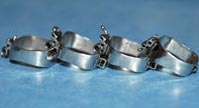
Tubes tested, mesh bases (manufacturers).
1. Unitek; 2. American Orthod.; 3. Lancer; 4. Ormco (Ti);
5. American Orthod.; 6. Speed, Strite Ind.; 7. Dentaurum;
8. Rocky Mountain; 9. Ormco 3MX, self-ligating;
10, 11. Rocky Mountain; 12. Ormco (A+); 13. Ormco;
14. Rocky Mountain; 15, 16. Unitek; 17. Speed,
Strite Ind.; 18. American Orthodontics; 19. Ormco;
20. Idem (Ti); 21. Unitek; 22. Ormco (A+);
23, 24. American Orthodontics;25. GAC
Why some tubes do not bond as expected
Just “presumptions”?

Tubes exhibiting the same mesh, but differing in depth.
To compensate, the manufacturer has etched the first’s base.

Structure of some multi-layered tubes. The red arrow
represents the deformation. Maximum stress bearing
areas are marked with grey.

1. Self-ligating brackets and friction

Arrangement of a dynamometer (tubular scale) and the
of the archwires used. 1. Weight to immobilize the scale;
2. Scale; 3. Parts of arch wires; 4. Sliding attachment

Arrangement allowing the recording the force
opposed to the ligated bracket
2. Bond Strength’s “Mass Testing” of Orthodontic Attachments

Bond strength tester with a “teeth holder” which
self adjusts to tensile by the force exerted.
3. Manufacturers encourage recycling !

In-Ovation R bracket exhibiting holes

Unitek’s Damon 3MX brackets exhibiting
dentification marks in slot

1. “Orthodontic biomaterials. Properties and Problems”

2. Complications of the Tongue Cancer Treatment – A Case Report

C G Matasa’s PET Scans, September 2006, and
September 2009. The white spots reveal tumors
3. Self-ligating brackets’ malfunction:
is it due to corrosion ?

Forestadent’s Mobil Lock bracket (1979). Section, brass and then stainless steel “variable slot”

In-Ovation bracket™. a. Before corrosion;
b. Open to show source of blockage; c. Detail

Effect of a. electroless copper plating (test for passivation)
and b. of corrosion on the same self-ligating bracket
4. Where are the Edward Angles and Rafael Bowens of today?

1. Self-ligating brackets, a gain for
almost everybody

GAC/Dentsply’s In-Ovation R ™bracket: view of the clip
and its closeness to the base. The latter is so thin
that the brackets’ welding lines are apparent.

Ormco’s Damon 3MX™ bracket: view of the sliding door and
of a hole above the base destined to receive a power arm

Group of In-Ovation R™ brackets seen as debonded.
Observe unscathed bases and mesio- distal
whitish borders of the cured adhesive.

Bases of Demon 3MX™ brackets seen after adhesive
removal. The first, a, like most of the others, was very
likely de-bonded by mesio-distal attack,
in contrast with the other, b.
2. Self-ligating brackets’ malfunction:
is it due to corrosion ? II

Self ligating brackets, with and without their
sliding door/clip, showing corrosion

View and section of the self-ligating brackets subjected to accelerated corrosion. The areas prone to malfunction
are shown lightly colored
|
|

Aging as a function of time & temperature

The accelerated aging schedule corresponding to
the orthodontic treatment ("The 10° degrees rule"
for 2 years at 37°C)
Sometimes, dreams can come true...

Pressure cooker in the oil bath.

Insulated oil bath containing pressure cooker.
1. Regulator on the cooker’s lid controlling steam escape.
2. Mercury thermometer. 3 Thermoregulator. 4. Plastic tank.

1.
Wanted: a grid of brackets’
strengths and weaknesses.
An engineer’s approach.
2.
Bond strength of various bracket
base designs

Force needed to debond brackets:as such
(black: Kgf, median, 25% and75%); considering
base area (red, MPa).

Bases of the brackets tested
as shown in Fig.6.

1.
The best in orthodontic light cure
is in reach.
An engineer’s approach.
2.
A do-it-yourself, personalized powerful
LED light for less than $50?
Basic materials for a high intensity
LED light. 1. LED, 2. AAA alkaline batteries,
3. Aluminum spike

Left: Mounted LEDs: Observe the aluminum spike
used as both heat sink and support.
Right: Bonding with the help of a high intensityLED
powered by 5 AAA batteries

Left: The convergence of two high intensity
LEDs provides enough energy.
Right: ShapeLock allows any desired shape
which can be quickly immobilized

Average bond strength obtained when curing
with several lights arrangements at a 30 sec illumination.
Adhesives: LB: Light Bond™; QC: Quick Cure™
Lights 1: QTH Light, LA 500; 2. Star configuration of common LEDs; 3. Single Luxeon Dental; 4. Two converging ones
3. NEW: READ THE “INSIDER” EITHER
IN HTML OR PDF !
4. Vatican Penance: Forgive us Our
Carbon Output!

1. Our New Year’s gift to the profession:
A simple and accurate way to measure the strength of dental materials and bonding

A potential “in vivo” arrangement of
the digital force gauge
2. Stainless steels, acids, and salts:
friends or foes?
3. Making Friends of Foes

Self ligating brackets after an exposure to a gel containing
lactic acid and table salt (ISO standard) and to a
reagent detecting leached nickel.

Installation for testing
corrosion resistance
4. Bisphenol A (BPA): read this only after
the holidays...
|
|